
If we are to continue to buy into our collective sapien narrative, then there is no side stepping the monster that is the internet. For better or for worse, the birth place of social media and the death of print media. For journalists this means a presence across multiple platforms in order to maintain relevance in a sphere driven by bizarre algorithms and uncertified news sources. In this emergent culture of participatory journalism, the ‘citizen journalist’ has added their voice to the sphere as well.
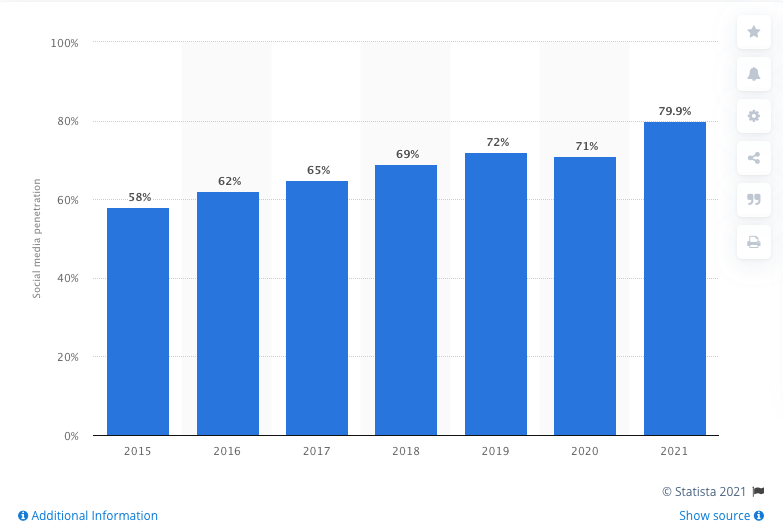
Social’s provide a degustation of news and information and in our current attention economy, journalists need to be aware and discerning in their mode of delivery, or perish into irrelevance. The ability to relay stories to the minute, without traditional parameters makes for a dizzying influx of news narrative as a majority of stories are now delivered digital first. As denoted below, Australian’s have developed greater trust in online news sources and interaction is only growing. Likewise for journalists, a Cision survey found that more than half of the 1.5 million journalists and influencers interviewed said they could not work without social media (Wilson pg 22). So how do journalists effectively use social media to explain context and impact of news events? This explainer will take a peak at The Chaser’s use of social media and their contribution to the fourth estate.
The Chaser team are well known for their political satire spanning back to their days on the ABC, the Chasers war on everything. The parody slant is an important journalistic function as it expands the conversation and often highlights the absurdity in our systems. Satire when executed well, can be informative and effectual at capturing our attention. Equipped with journalistic backgrounds, the chaser crew delivers witty insight enacted in novel ways to take sly shots at Australian politics. Therefore their intension isn’t to break news, rather they’re firing off humorous backhanded retorts to political and social discourse as it plays out. We are informed via inference.
This years federal budget was recently announced and as expected, many took to the keyboard to express their disdain toward the governments spending plans. In the attention economy, short, punchy posts are key as recent studies reveal our average attention span is decreasing as over saturation and an urge for new information increases. Twitter, has a limited character per post restriction so @chaser used a video to convey what the budget entails and how those ramifications might play out for us. It’s a clever use of the limitations of twitter as video’s will auto play in a feed whereas article links need to be opened in another tab.
Twitter is the third most utilised platform for news, with facebook and Youtube dominating. With more pressure for the general public to be their own gatekeepers of news, the blue check tick verification symbol in Twitter certainly aids in funnelling authentic information to your feed. Stipulations around gaining it include being in top one percent with followers geographically, although being on top doesn’t always equate to truth or validity. The Chaser utilises multiple platforms but it is the same content across board, as to align with everyones varying platform preference.
Satire isn’t an easy method to apply to current events and has landed the Chaser team in hot water on multiple occasions. The news is inherently grim or confronting so this modality obviously wouldn’t work for reporting on war or disasters but is well executed when it comes to the dissection of the government. Twenty four hour a day access to information in & of itself is a mental hindrance and coupled with a pandemic has left many doom scrolling through this inundation. This is where the Chaser owns its niche angle, injecting some light in a realm naturally skewed to the negative, laughter is key.
As are facts. One of the biggest pitfalls of the online world is the infiltration of misinformation or the intentional method of disinformation. It can even often be difficult to discern the context of an image linked to a story let along the content & despite the verification of an account, factchecking is impervious in journalism. In regards to the Chaser, prior knowledge and context is most certainly implied, to read their articles would be befuddling if you lacked the background story or perhaps had english as a second language. Wow those Aussie’s must have a real ejaculate problem if they are considering throw away desks in their parliament.
Jokes are high currency and offer an extra layer of deliberation around an issue and the Chaser’s adaptation to social media has meant we can continue to laugh while we cringe at current affairs. They boldly highlight the farcical but are transparent and unfiltered with their humour. In a world of increasing political correctness, humour is an avenue to continue to question the powers that be and exercise freedom of speech in a diminishing landscape. Jokes aside, the power has been somewhat relocated to the overlords of the platforms and as journalist, it’s important to note that they can silence you at any time.
Reference – Wilson, Y., 2019. The social media journalist handbook. Taylor and Francis.


 Jane BAMBI Drew
Leave a comment