‘Google is not ours. Which feels confusing, because we are it’s unpaid content providers in one way or another. We generate product for google, our every search a minuscule contribution. Google is made of us, a sort of coral reef of human minds and their products ‘
-Gibson, 2010
Paul Stamets, mushroom guru states nonchalantly in his Ted talk that fungi consciousness created the internet so that our species could better communicate. Just something to muse over as you read this via the megalithic conduit through which our global society pulsates. These networked compositions of connection, have resulted in economic, cultural, media,social, and political activities related mainly to the information economy (R. Jeljeli et al 2021) and offer a voice beyond traditional media methods. Wilson (2019) describes Citizen journalists as non professional journalists who disseminate information from around the world and can provide live information from disaster scenes or information that no one else has. This can be crucial in extreme instances such as school shootings or conflict zones to warn & inform people instantly via information sharing platforms.
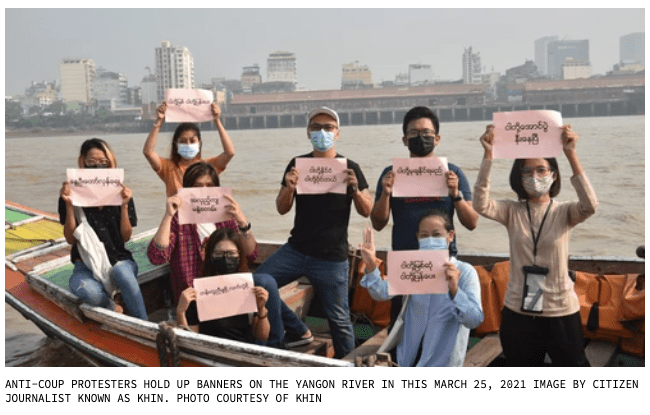
Myanmar is an example of a country that currently relies on citizen journalists to inform the globe as the military continue their crackdown on press in an attempt to muzzle information on the coup spreading. Communications with Vice indicate that locals are using platforms such as twitter #whatshappeninginmyanmar and even old school methods like radio to communicate the oppression. There are positives and pitfalls in regards citizen led media including ‘self editing’ (Lynn, 2020) and the beholders personal bias and potential lack of diversity of sources. Of course similar sentiments could be held for media institutions but in situations where outside journalism is limited or forbidden, I think conveying a multidimensional scope could be problematic.
Once traditional news media moved from papers and television to the rapid paced fourth estate, the possibility for non credible sources and misinformation, willing or otherwise has become virulent. This information highway has empowered the voices of the average citizens, an important element for countries whose governing bodies regulate speech and information or lack centralised media. We are all to a degree citizen journalists, simply by contributing to the online platforms we populate.
The communication and media sector has benefited from the emergence of the second generation of the Web (Wb2.0), which embodied the features of the network society, characterized by the ability to provide everyone with the opportunity to participate in its structure and content. This is positive in a multidirectional manner as a global society, we can garner information on events we would otherwise be blind to and in turn help.
I will never forget evacuating from my property due to wildfire and the fire crew telling me to use to twitter to find out crucial information about the status of my home and whether roads had been closed etc, ‘it’s more informed than us, ma’am’.
-Meikle, Graham & Young, Sherman 2012, ‘From broadcast to social media’, in Media convergence : networked digital media in everyday life, Palgrave Macmillan, Basingstoke, pp. 59-78
-JELJELI, R.; SETOUTAH, S.; FARHI, F
Citizen-Journalist Dilemma Between Media Freedom and Professionalism
Utopía y Praxis Latinoamericana, vol. 26, no. Esp.1, 2021
-Nyan Lynn (2020) The danger of words: major challenges facing Myanmar journalists on reporting the Rohingya conflict, Media Asia
-Wilson, Y (2019) The Social Media Journalist Handbook, pg 138


 Jane BAMBI Drew
Leave a comment