
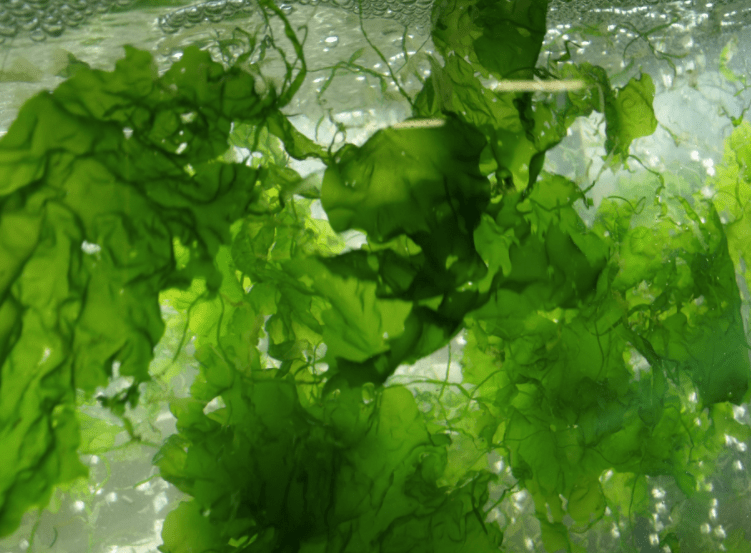
Seaweed has superpowers and may just be the answer to our Anthropocene dilemma. Our omnipresent climate catastrophe is daunting to say the least but there is hope in the almost science fiction answer of seaweed aquaculture. Research and action are underway in New South Wales so that we might curtail a future akin to Kevin Costner’s Waterworld.
As an island nation, we are well-positioned to look to the seas as a utilisable answer to our climate question. Our unique seaweed species with new ones yet to be discovered means we need ongoing research into how to cultivate it. Seaweed is an excellent biomass producer, grows 50 times quicker than land plants and is as old as the Earth. Herein lies the key to rerouting our industries from destructive to productive and shifting our embedded neo traditions around how and what we eat. Dr Pia Windburg of Venus Shell Systems cultivates seaweed to create food and nutrition products. She believes seaweed can alleviate the pressures that land-based agriculture has on the environment and she has the motto that if we can replace 10 per cent of our food intake with seaweed we will be on a productive path to environmental gains. Dr Windburg is championing this emergent industry in Australia but firmly believes that we need to do it right so as to pave a foolproof path into the future.
Located in the Shoalhaven, Dr Windburg is using seaweed to close the loop in the system of the production cycle of a neighbouring flour factory. ‘Nutrients are nutrients wherever they are and here on the south coast, there are giant food processing plants that have nutrient streams that are lost to the environment that we are able to capture. This allows us to reduce the nutrient load in the catchment and we can grow a new product without the creation of synthetic fertilisers, which create a lot of carbon emissions and other energy inefficiencies.’ She said.
It’s an awe-inspiring cycle that Dr Windburg has implemented; she is using a variety of seaweed that she discovered referred to as Ulva 84 which is related to Ulva and sea lettuces but is unique in its composition and versatility. Out of 11,000 seaweed species, Australia has roughly 3000 unique species. ‘There’s a lot of interest in seaweed and there will be many systems and species that come online with other companies but we are currently the only food-grade company in Australia with a decade of research behind us.’ She said.
Dr Windburg cites the beef industry as a major source of environmental degradation and disputes the use of seaweed to support this industry, ‘People in Australia are feeding their cows seaweed and selling this story but I find it a bit damaging to our real progress on our planet. The carbon capture solution is here, let’s not throw it at burping cows.’ We are in the dawn phase in Australia in terms of the aquaculture industry but as Blue Carbon can sequester two to four times more carbon than land plants, it is a promising avenue for our pressing challenges. Dr Windburg adds that this idea is a scalable solution that is crucial to see a real change in our climate crisis.
Nicole Morahan who is completing a master’s in sustainability is helping Dr Windburg to back up some of the assertions she has made around her business. Miss Morahan is doing this by monitoring the sensors that are located in the seaweed ponds to measure the carbon, nitrogen, nutrients and water input that occurs in the seaweed pond and on the intake pipe that comes from the starch plant and also the outtake pipe connected to the ocean. This allows her to track the nature-based, recycling and material inputs and correlate the information into a cohesive template. ‘She is using waste resources to grow the seaweed and make the food and this inherently reduces the burden that we put on the environment and I’m going to quantify exactly to what extent.’ She is assisting in the development of monitoring systems so that the real environmental gains can be measured and implemented with precision and certainty. Currently, aquaculture doesn’t receive any funding from the government so Miss Morahan’s mission is to crunch the numbers by doing a side by side data set proving the viability of seaweed against grain and quantifying how much carbon is sequestered from seaweed and commence the conversation of eliciting blue carbon credits from the government.
She needs to pick a function that is measurable and says she having trouble comparing grain with seaweed, ‘the nutritional quality of seaweed powder is just light-years above.’She said. Seaweed’s nutrient profile is up to twenty times that of land plants and it proliferates in B12 and iodine, which are hard to find in other food types. So the global research is there but Miss Morahan laments that after working in the corporate world and seeing big ideas cycle through, they all had something in common. ‘They had big money behind them. Dr Windburg is a scientist and so we have this mismatch where we need big businesses to throw themselves behind this.’ She said.
Whilst we can’t just eat the carbon, its utilisation will lessen our need for traditional land-based agriculture and thus naturally begin reducing our impact. Jo Lane, a Marine biologist and owner of Sea Health products on the South Coast recognises that there is a long road ahead, ‘It’s a chicken and an egg thing because there’s not a lot of research because there is no market, but as we import 40 million dollars of seaweed products annually we have the ability to fill this gap.’ Lane and her family harvest wild kelp and after significant research have had initial success with the breeding cycle of one of our unique kelp species and are now able to grow it in the ocean via long lines tethered to an anchor. Some species of seaweed can grow up to 30cms a day so whether grown in the ocean or a pond, the production potential is immense.
The UN global compact strategy states that we are in a decade of action and that their path of action lies in accountable companies and enabling ecosystems. In their mission statement that just came out, they recognise that seaweed is a nature-based climate solution. In an arid country unshackling our demand for freshwater is pivotal. Seaweed cultivation requires no land and as stated in the Seaweed Manifesto, land agriculture creates roughly 24 per cent of global greenhouse gas emissions. Could this be the sacrament that reconnects us to mother earth? It offers us a speedier solution that is zero input, can be utilised as a biodegradable form of plastic and can be made into corn chips among a myriad of other things. Miss Morahan says, ‘It’ll take behavioural change and hard work but it’s a real solution.’


 Jane BAMBI Drew
Leave a comment