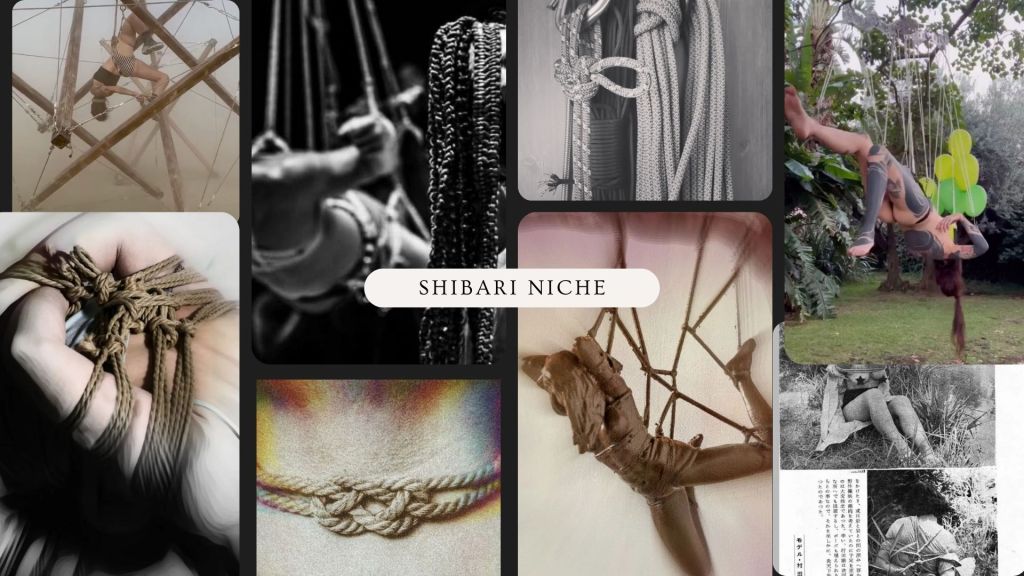
Congratulations, you’ve made it to the end (for now) of my auto ethnographic adventure into the Shibari Niche, where I discovered the overt and often covert nature of this realm. In response to the prompt at the start of semester as to why this niche; I can extrapolate more elaborately now. My exploration into Shibari began as a personal quest to deepen self-connection and learn the ropes, using the lens of social media to examine its reception beyond the veneer of kink. While a single semester falls short of plumbing the depths of such a complex field, my journey yielded significant insights and a newfound addiction to digital crack cocaine (Koetsier, 2020) aka TikTok . Engaging with fellow creators, I navigated the intersection of persona and positionality, applying classroom theories to carve my unique (questionable) space within this niche and the emergence of new digital platforms has made lived experience possible in new ways (Pink et.al, 2016). My skillset expanded to include elementary Shibari ties and refined editing techniques, and I felt anchored by a sense of belonging within this community.
Initial perspectives and exploring delineated an intention to skirt around Shibari’s ties to the broader BDSM world. However, I quickly realized the two are inextricably linked and must be discussed collectively for a holistic understanding. My early perception of Shibari was as an endeavor primarily artistic and aesthetic. Yet, through immersion and online persona evolution, I uncovered a rich tapestry of participants varying in gender, age, and geographical background. This diversity underscored the universality of Shibari’s appeal, transcending what I had once viewed as merely a visual spectacle, and highlighting its role as a dynamic conduit for human connection and self-discovery. In an auto ethnographic lens, the interpretation and related analysis of observations is foreshadowed by the researcher’s orientation toward, or relationship with, that which is being observed (Marvasti 2014, pg.356). What was included or excluded in my niche felt like a cognitive decision, but rather I was guided by concepts that made some detail more important and relevant than others (Marvarsti pg.359). Taking stock of my bias throughout this process was intriguing as I observed my filtration process and persistently looked into my observations and participation.
My first epiphany was that many were using Shibari on socials as gateway, thumb nails were a semiotic marker of persona. Their presence was a covert and curated expression of what was permissible on socials and unguarded content could be more freely accessed elsewhere. This lead to unbridled topic exploration that I previously believed wouldn’t have existed in an academic setting, I was caught in a web of fascinating research on many facets of BDSM that even had the inception moment of alluding to why ethnography in this realm may have frictions. In the same way that BDSM can be explained as a power exchange, my content creation sought to be an empowering exchange as a produser with the intention of challenging discourse in this arena. Parry & Johnson suggest that despite the recent and rapid growth in multi disciplinary research on BDSM, our nearly 30 years of observations in both academia and BDSM communities suggest that the tensions and challenges associated with BDSM research generally remain connected to fear, generating distrust and stigmatisation (pg. 41, 2021). Auto ethnographically speaking, there was a constant degree of reflexivity throughout my entire process of content creation. Would I have been riskier or more flexible, if it wasn’t for a university project? I chose my level of visibility, vulnerability and moderation across platforms, whilst adhering to the sensitivities of this niche and platform guidelines.

Fan fiction exists in this niche?! I don’t think I’ve ever questioned how I analyse insights from observation and research, aren’t we just us? Cybernetic beings intersecting with and spewing data?At the onset of my foray into this roped niche, I rudimentary thought I has good idea about the depth of this space. That it was all just pretty girls playing with poses and I wanted to be in the club. But as an ex yoga teacher, I keep the buddhas teachings in the back of my mind; have a beginners mind. This imbues shedding bias and welcoming the unexpected, key concepts in ethnography. As Jay Hasbrouk suggests (2018, pg12) They follow research participants, ask questions, try their hand at new practices, learn the local lingo, and immerse themselves in the daily experiences of their figurative “master.” Appropriate much? I have discovered #whipwednesday #kinktober & #spiceymop, of course this community has a playful side, but it wasn’t immediately apparent to me and I was trying to garner how the intersection of kink, culturally approriated practices and fringe culture would collide. Employing elasticity of thinking that traverses between open explorations and making occasional connections to other domains (and back again (2018, pg12) broadened my lens; my dreams of narrowing in this niche were unravelling. Discovering the fan fiction aspect of this realm through a month long Shibari drawing competition was a surprising epiphany. I had stumbled upon a whole subspace of inclusion of participants that were experiencing the niche in an entirely different format. I don’t draw but I shared stories pointing my followers to this event, the more I interacted, the more the algorithm shot me in the direction of other intriguing accounts. Which leads me to this.
The dungeon had some unexpected players In moving from specific observations to a generalists trawling of this niche, I found the field site to populated by unexpected players but of course there were stakeholders outside if my pre determined bias. It’s almost impossible to come across Shibari in the wild, upon the gemination of my content creation I was astounded by messages from my peer group (that is predominantly overseas) that had dabbled in or had interest in this niche. By revealing aspects of myself, others felt comfortable in uncloaking to a degree. Research suggests that queer and same-sex attracted young people are more likely to rely on online information sources in learning about sexualities and sexual health (2013, pg 36). The dispersed and interconnected internet arena can provide a place for people to experience a stigma free environment and nurture learning, boy we’ve come along way from the creepy MSN chat rooms of my teens. From diverse body type and gender representation to discussions on consent ( although harder to find), this niche visibly appeared to engage with a broad audience that expanded far beyond the bunny / rigger dynamic I had previously only known this space for. I still have a high level of bias toward different apps, for instance I am confident in DM-img creators on instagram whose profiles seem more definitive and accessible, yet am weary of TikTok despite gaining more attention there. Negotiating the span of this niche was mind boggling, I did not anticipate connecting with people from Iran, Berlin and beyond. This phenomena could be explained by ephemerality which facilitates meaningful social interaction through enacting a site of momentary copresence that brokers awareness for the life circumstances of distant others (2021, pg 1439).
Circumnavigating back to Andersons definition of Analytic Auto ethnography, he refers to research in which the researcher is (1) a full member in the research group or setting, (2) visible as such a member in published texts, and (3) committed to developing theoretical understandings of broader social phenomena. I wasn’t able to solidify an overarching research question, especially as I integrated myself into the depths of the online world of Shibari, however I did feel that I could dissociate from myself in a way that afforded me the opportunity to watch myself exist in various fragmented spaces. Through this personal experience I have gained a modicum of postmodern sensibilities—especially the skepticism toward representation of “the other” and misgivings regarding generalizing theoretical discourse (Anderson, 377). This resonates strongly due to the nature of this niche and I’d like to think that I contributed positively to the notions of play, self expression and acceptance whilst eliciting valuable insights into how to create a powerful online presence in a world tethered to perennially shifting goal posts.
References:
Cultivating Curiosity, Ethnographic thinking, from method to mindset, Routledge, NY. Hasbrouk, jay 2018,
Byron, P, Albury, K & Evers, C 2013, ‘“It would be weird to have that on Facebook”: young people’s use of social media and the risk of sharing sexual health information’, Reproductive health matters, vol. 21, no. 41, pp. 35–44.
Schellewald, A 2021, ‘Communicative Forms on TikTok: Perspectives From Digital Ethnography’, International journal of communication (Online), p. 1437
Anderson, L 2006, ‘Analytic Autoethnography’, Journal of contemporary ethnography, vol. 35, no. 4, pp. 373–395.
Pink, S, Horst, H, Postill, J, Hjorth, L, Lewis, T, Tacchi, J 2016, ‘Researching experience in digital ethnography: Principles and Practice. Sage, LA
Parry, DC & Johnson, CW 2021, Sex and leisure : promiscuous perspectives, Routledge, Taylor & Francis Group, Abingdon, Oxon
Marvasti, B Amir 2014, ‘Analysing Observations’, The Sage Handbook of qualitative data analysis. Use Flick editor, Sage: LA


 Jane BAMBI Drew
Leave a comment