Yahtzee was the glue of my family gatherings: five plain dice routinely whipped out at Christmas or on Sunday arvo’s. The scorecard was lorded over by my father, whose constant commentary and narrative arc injected an all encompassing aura over this simple game . I ached for no other game in my youth and point blank couldn’t fathom the intricately painted army of creatures silently multiplying on moss covered landscapes in my brother’s room. Fast forward and my game exposure remains pretty limited, I had an infatuation with the ornate and fierce tiled game of Mah-jong and religiously carried a deck of cards on multi-day hikes and long van trips. So with my virginal knowledge of the boardgames industry, it seems fair to ask, just what is a game? Simon Egenfeldt- Neilson et al. (2012) suggests ‘If we understand games to be a system (ludology), we risk obscuring the way games tell stories (narratology). We have to be attentive to the ways that games are both systems and stories.’ Moreover Brian S. Smith implores that games emerge as a society matures and develop more advanced political and social organisations (2012).’ Can. Worms. Open. Let’s go.
I certainly wasn’t anticipating spontaneously launching squishy burritos at my uni cohort or strategising to explode an opponents kitten (I would have preferred the NSFW deck) as we grappled with the set up, rule comprehension and rapid fire rambunctiousness of trying to eliminate each other in these table top games that we collectively had no prior experience with. Unicorn Dispatch describes design experience as ‘The surface of reality you interact with‘ and what was immediately apparent to me was the gravitational pull of each game in the sense of off kilter illustrations, wacky game antics and a variety of tactile elements. YOU ARE GIANT MONSTERS ON A RAMPAGE! I exclaimed to my co gamers a I began to deliver the rules of Kings of Tokyo. That didn’t happen (timid in group settings human here), we pulled the usual impatient manoeuvre of FiGuRe oUt the rULeZ, whilst you (hopefully) slay an opponent and reign victorious! Our group stuck with basic mode (there are advanced rules) and I observed myself being quite delighted with the mechanics, an epiphany was the moving wheels indicating health and victory points. However as I moved into the learning phase, oscillating between responding to game directives and building my arsenal, I realised there was a limited depth to this experience. A collective Ah HAH moment arose around the table when all realised that collecting hearts wasn’t going to win the game, strategise and attack baby!
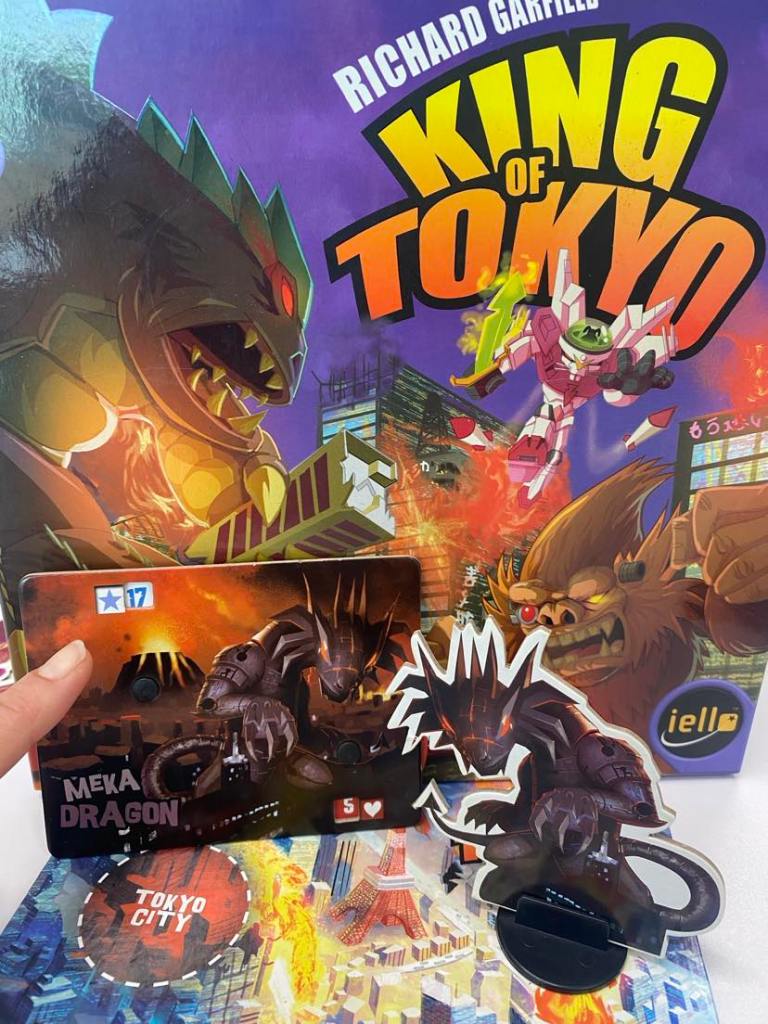
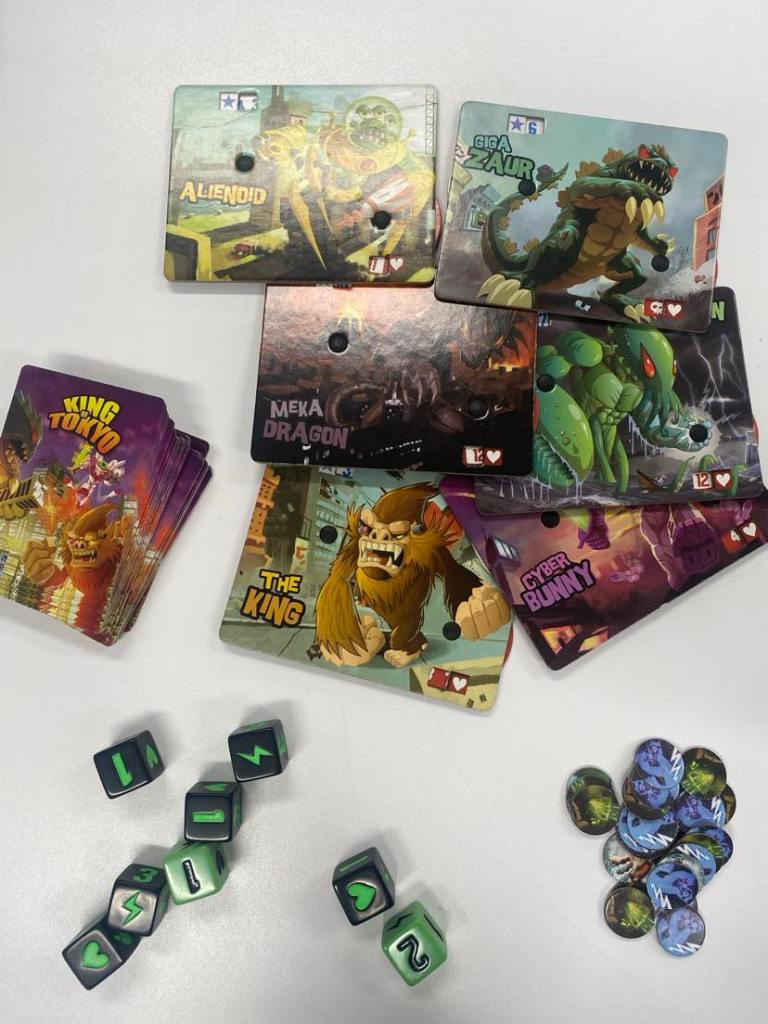

SO far, I’ve learn there’s more to life than dice, infact those little cubes can have symbols as well as numbers! Heck there are swathes of intricate mechanisations spanning from mass market games all the way through to the niche game industry. Back to King of Tokyo, which exudes Ameritrash characteristics not only with its plethora of cardboard features, thematic consistency and the use of recognisable and globally beloved characters. At first I just thought I was I had bunch of zany fantasy monsters to Choose from, but on closer inspection there’s King Kong, Kraken and Godzilla. {side note, there’s a tonne of extra characters up for purchase such as Trump so it looks like any monster can join in} The game designers choice of characters taps into cultural zeitgeists, adding an extra layer of pop culture nostalgia, bridges global markets and of course provides an easy platform to battle these iconic creatures of destruction. I chose Meka Dragon because dragons are GOAT but it too has an origin story beyond the game although I feel like Meka is a neo badass. In summary, KOT is accessible on a timeframe, doesn’t put your cognition in overdrive and includes enough randomness features (dice, cards etc) so as not to make Johnny a dull boy.
Let’s rewind to Marshall McLuhan for a sec, he provides a wholistic explanation of what games mirror in a society or culture thus prompting the reflection of what we are working through in our little slice of history. It’s quite telling with games such as Cards Against Humanity, I digress, ‘Games are popular art, collective, social reactions to the main drive of action of any culture. Games, like institutions , are extensions of social man and the body politics, as technologies are extensions of the animal organism. Both games and technologies are counter irritants or ways of adjusting to the stress that occur in any social group (pg 208/09, 1964)‘. Rolling with this sentiment and my newly minted experience in tabletop games, I have begun to ascertain how I may create my own immersive game. My affective response to the aforementioned games can be mathed as – relatively straightforward game narrative + a certain array of things (mechanics) I can tinker with + swiftly onboarding rules = a desirable social outcome. I’ll leave you with a quote from psychoanalyst G.C Jung commenting on play, ‘The creative mind plays with the objects it loves.’ (Egenfeld-Nielson et.al (pg, 30)’ Do I love the dice or the burritos that I’ve interacted with? I wouldn’t assign that level of emotion but there is certainly a level of projected affection toward the characters, scenarios and inherent camaraderie that is evoked in the connectivity of game play . I feel I am standing on the precipice of myriad worlds that game play affords.
References:
Egenfeldt-Nielsen, S, Smith, JH, & Tosca, SP 2012, Understanding Video Games : The Essential Introduction, Taylor & Francis Group, Abingdon, Oxon. Available from: ProQuest Ebook Central. [15 March 2024].
Unicorn Dispatch AKA Richard Hall – pearls of wisdom from class
McLuhan, M 2001, Understanding Media, Taylor & Francis Group, Florence, USA. Available from: ProQuest Ebook Central. [15 March 2024].


 Jane BAMBI Drew
Leave a comment